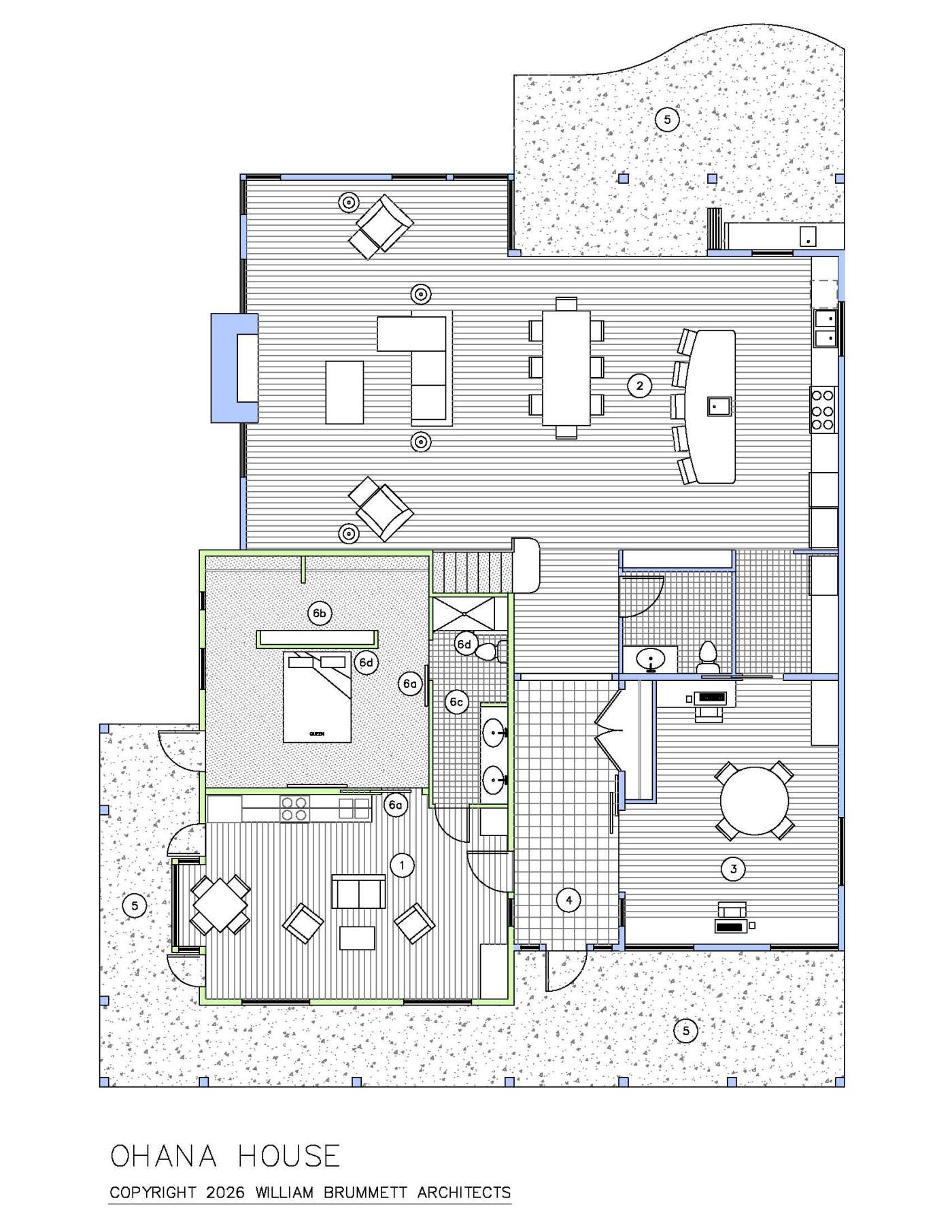
The Ohana House is another design we have been exploring that could serve elders or others approaching the “tipping point” in needing support. Ohana means both “family” and “house within a house.”
Some of our previous blogs have discussed our research regarding the needs of those aging independently, often alone, who begin to reach a tipping point where their living situation may no longer be completely safe and well. Some people living in this predicament have a fear of falling, an accident, or a medical situation and not being able to call for help. Others need a helping hand up many times throughout the day. Some are lonely and isolated, missing someone to venture out into the world and share the day with. While still others simply feel a lack of purpose.
The question pushing our work daily is- “what other options to meet this need, not just for elders but others with challenges, could there be? Specifically, how can we develop living options that provide this initial level of casual oversight, a helping hand, and community and companionship without requiring expensive, licensed care, and without diminishing ones sense of independence, continued ability, and value?” Let’s explore some.
Hanai House, our design concept highlighted in a previous blog, explored the idea of a small household of four unrelated people, where the four help each other as a chosen family .
Ohana House explores the idea of a small house for elders within a larger house of a younger family. The elders may provide an afterschool or date night childcare component for the younger family, while the younger family provides some safety and oversight. Both combine to form an extended family that lean a bit on each other and benefit from having a broader expanse of ages under one roof, creating a greater and richer whole. True community involves commitment, turning proximity into shared purpose and mutual care.
I owe a debt of gratitude and inspiration for this particular concept to my good friend, colleague and adventure compadre Ken, who along with his wife and family, actually built a similar setting.
The key design elements of Ohana House, shown and numbered in the floor plan, include:
1. A self-contained small house includes its own small kitchen, dining area, living room, bedroom, bathroom and storage
2. A larger house connected to the smaller house includes large kitchen/dining/living for private or shared meals, pantry and powder room on the first floor, with bedrooms on the second floor
3. A shared home office or art room for both households to use together
4. A combined central entry, with an entry to the smaller house from the interior shared foyer. Separation between the foyer and smaller house has a glazed door and sidelights for casual connection
5. Each house has its own covered outdoor porch area
6. The smaller house is designed for aging in place, with:
a. Barn or pocket doors allowing ease of view and flexibility
b. Open closet behind bedroom head wall
c. Ample bathroom for accessibility and future use with grab bars
d. Call tablet mounted near bed and toilet, for easy, quick call to family or professional assistance
f. View from the bed to the toilet and living room supporting those with memory loss
It’s important to note that connecting the two households together within the same building is a critical aspect of Ohana House. A typical Accessory Dwelling Unit, separated by a yard, does not accomplish the casual yet frequent connection of Ohana House. Connecting the households physically and providing some shared space encourages many more interactions between the two households.
Privacy and choice is maintained in Ohana House as each of the two households has a complete set of private spaces. Each can completely function on their own. Each can entertain guests as desired, apart or together.
Ohana House could be created and occupied by actual family members, such as parents living with their grown child’s family, or unrelated people who jointly want to improve their financial situation as well as their safety, companionship, and the richness of their lives.
Like our previous Hanai House model, Ohana house could also be an offering on a campus setting, expanding the choice of options in a continuum, and expanding the age range living in community.
We remain committed to challenging the norms. Drawing through challenges to discover opportunity is the art of our occupation, and what drives us. For 26 years we have created innovative assisted living, memory care and settings for others with challenges and firmly believe that these are an important piece of the solution. Yet we remain hopeful that insight, creativity and wisdom will show a new and expanded way. Not one way, but many ways.
“Alone we can do so little,
Together we can do so much”
Helen Keller
Bill Brummett
Principal
William Brummett Architects
Concerto Consulting

